Curtains for tracks


Curtains for tracks: with multi-purpose tape and hooks
If your window has a track rather than a pole, you need a different curtain. A track can't be threaded through anything, so the curtain has to hang from hooks, and for that it needs tape along the top. This is what we call multi-purpose tape, or pencil pleat tape.
These curtains also work on a pole, so they're the more versatile of the two headings we make. They all come with iron-on tape so you can adjust the hem with an iron, without sewing, and they're sold individually.
3
Ways to hang it: track with hooks, pole or double pole.
2
Finishes with the same curtain: gathered or flat drape.
0
Seams. The hem is adjusted with an iron and iron-on tape.
What is multi-purpose tape
It's a band of fabric sewn along the top edge of the curtain, with a row of pockets where the hooks go in. That band is what lets the same curtain work on a track, a pole or a double pole, and it's what lets you decide how much gather it has.
With hooks, for tracks
This is its main job. The hooks go into the tape pockets and then onto the track runners. The curtain hangs below the track, which hides the mechanism and gives a clean drop from the top.
On a pole too
The same tape lets you thread a pole straight through it, without hooks. Handy if you move house or change windows: the curtain doesn't become useless because the hanging system is different.
You decide the gather
This is the real difference from eyelets. With eyelets the fold is set at the factory and always falls the same way. With multi-purpose tape you choose: bunching the fabric gives a dense, decorative gather with a more classic feel; spreading it out gives a flat, relaxed drape. The same curtain, two different results.
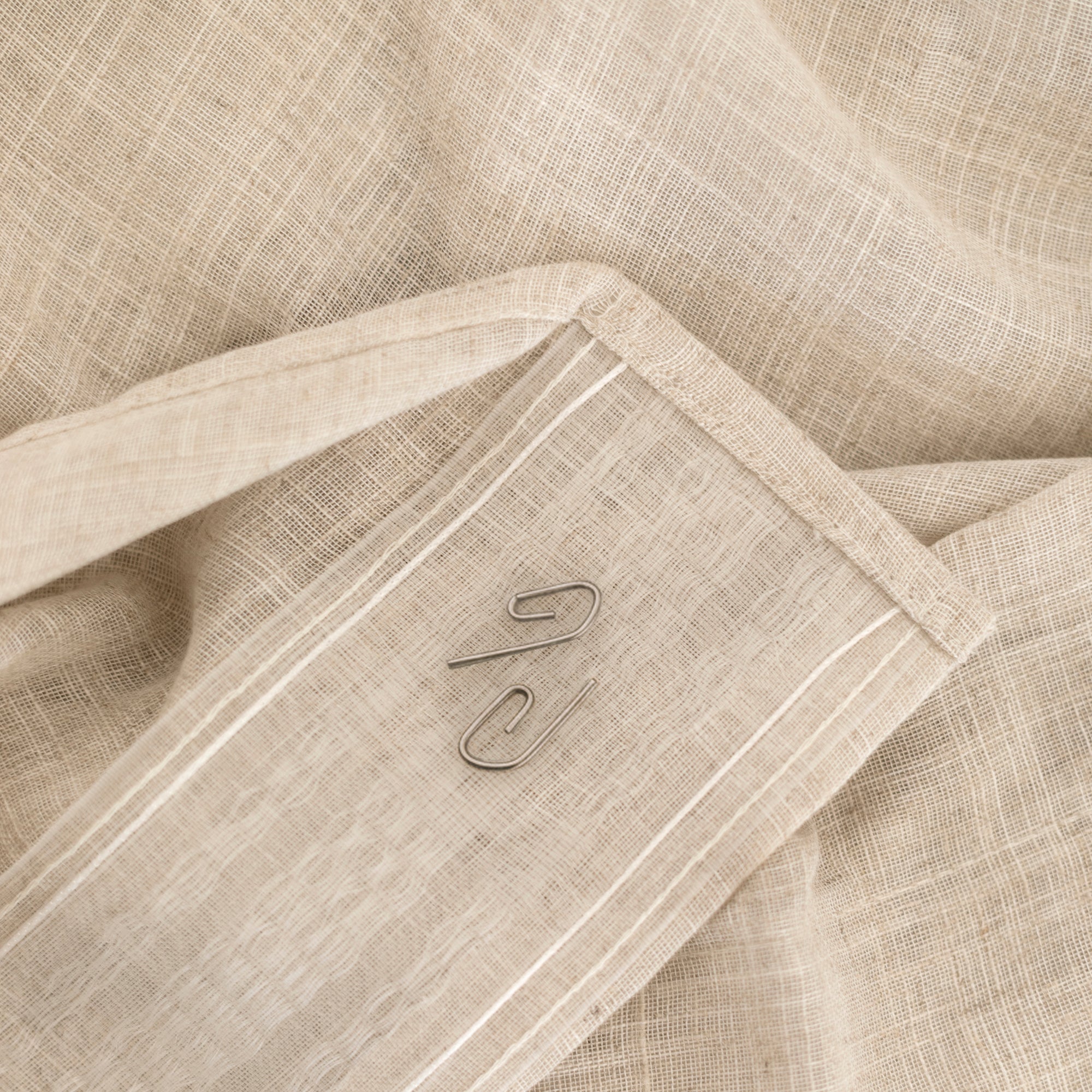

With multi-purpose tape
Hooks for a track, or a pole straight through. And you decide the finish, from dense gather to flat drape.
The one you need if you have a track
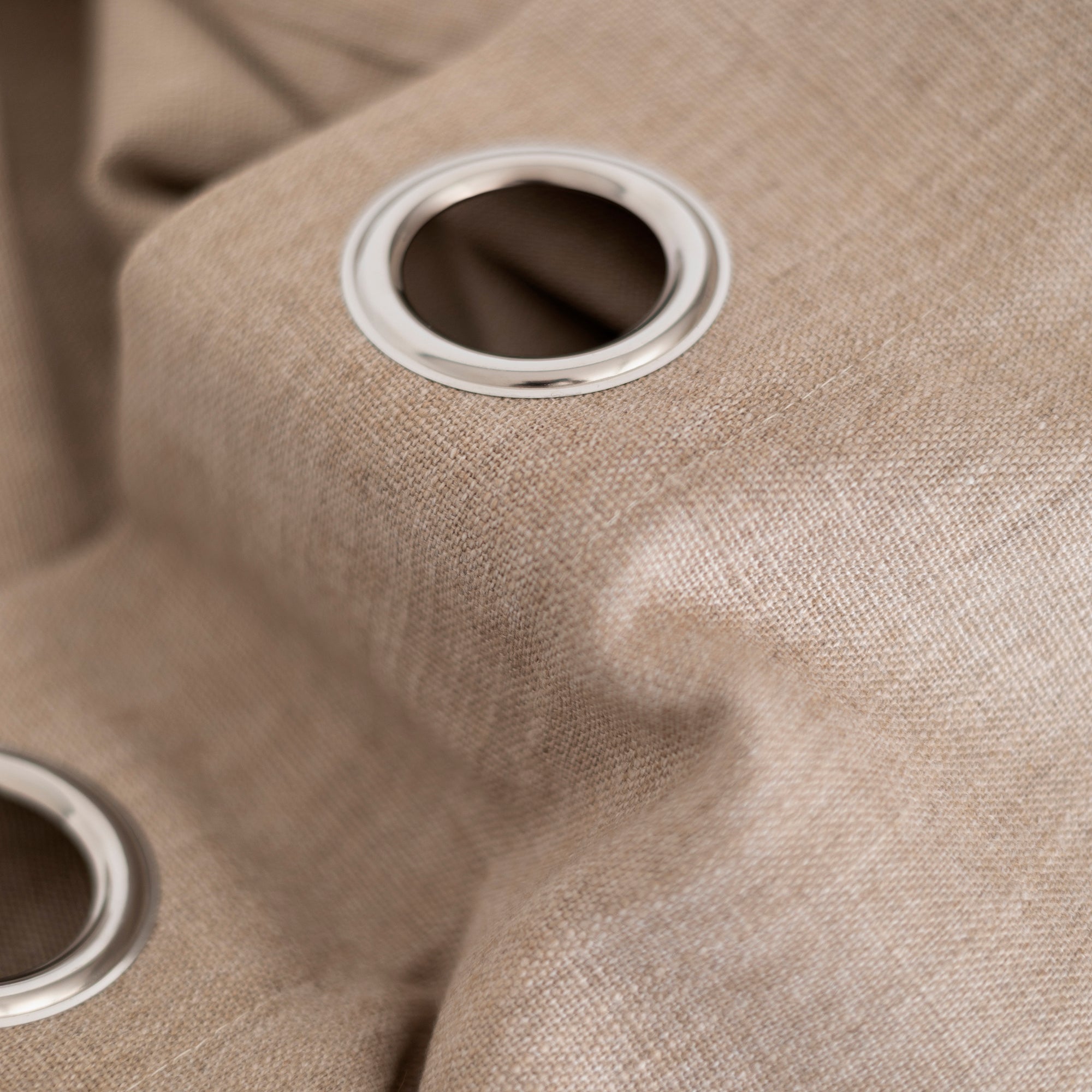

With eyelets
Thread the pole through the eyelets and it's hung. Quick and with an even drape, but it only works on a pole.
| Multi-purpose tape | Eyelets | |
|---|---|---|
| Works on a track | Yes, with hooks | No |
| Works on a pole | Yes | Yes |
| Track or double pole | Yes | Tricky |
| Gather | You choose | Set at the factory |
| Speed of hanging | Medium | High |
| Style | Classic or relaxed | Contemporary |
If you have a track fitted, the decision is made: you need multi-purpose tape.
Track or pole: what changes
It's not just a matter of taste; it changes how the curtain behaves and what you can do with it.
The track disappears
A track is fitted flush to the ceiling or recessed, and it's hidden behind the curtain itself. The result is that the fabric seems to come out of the ceiling, with no visible hardware. It's what makes a room look most elegant, especially with low ceilings, because nothing breaks the vertical line.
A track runs more smoothly
The runners on a track glide along a guide, so a large, heavy curtain opens with one finger. On a pole, the eyelets rub against the metal and on wide windows you have to pull hard. With a large window or a sliding door, you notice the difference every day.
A track takes two layers
A double track lets you hang a sheer curtain on the inner line and a denser curtain on the outer one, and it's the complete way to dress a window: the sheer drawn by day, the curtain closed at night. You can do it with poles, but it needs double brackets and looks bulkier.
01
Measure the track, not the window
The width that matters is the fitted track. Multiply it by two: that's the total fabric you need across all panels so the curtain falls in folds instead of pulling tight.
02
Put the hooks in the tape
They go into the pockets of the multi-purpose tape, spaced evenly. The more hooks and the closer together, the denser the gather.
03
Hook them onto the track runners
Each hook goes onto a runner. Start at one end and work along in order so you don't leave loose runners in the middle, which is what makes the drape uneven.
04
Adjust the hem with an iron
With the curtain hung, mark where it touches the floor and take it down. Fold at the mark, place the iron-on tape included and iron it. No sewing and no visible seam.
How many curtains and how many hooks
Measure the width of the track and multiply it by two. Each curtain is one panel, so a standard window track needs two, one on each side, and a wide window usually needs four. If the panels add up to exactly the track's width, the curtain hangs tight and flat.
Hooks are sold separately and depend on the gather you want: more hooks closer together give a dense gather, more widely spaced ones give a flat drape. Also check that your track runners are compatible with standard hooks before ordering.

Frequently asked questions about curtains for tracks
Which curtain do I need if I have a track?
A curtain with multi-purpose tape, also called pencil pleat tape. It's a band sewn along the top edge where the hooks go in, and they then hook onto the track runners. Eyelet curtains don't work on a track: they need a pole to pass through the rings.
Are hooks included?
No, hooks are sold separately. That's on purpose: the number of hooks and the spacing between them determines the gather, so it depends on the finish you want and the width of your track. Check that they're compatible with your track runners.
Does the same curtain work on a pole?
Yes. Multi-purpose tape lets you thread a pole straight through it, without hooks, as well as hang it on a track. It's the more versatile of the two headings we make, and the right one if you might change your hanging system later.
Do you sell tracks?
No, just the curtains. Here you'll find curtains made with multi-purpose tape, which hang on a track with hooks. The track and runners are hardware you can buy at a DIY or home decor shop.
What's the difference between a track and a pole?
A track is fitted flush to the ceiling and hidden behind the curtain, so the fabric seems to come out of the ceiling and nothing breaks the vertical line. It also runs on runners, so a large curtain opens with one finger. A pole is visible and part of the decor, but on wide windows it's harder to open.
Can I hang two curtains on a track?
On a double track, yes, and it's the best way to dress a window: a sheer on the inner line, close to the glass, and a denser curtain on the outer one. The sheer stays drawn by day and the curtain is closed at nightfall.
How do I get more or less gather?
With the number of hooks and how far apart they are. Bunching the fabric with more hooks close together gives a dense, decorative gather with a classic feel. Spreading it with hooks further apart gives a flat, relaxed drape. It's the same curtain with two different results.
Can I adjust the length without sewing?
Yes. Each curtain comes with iron-on hemming tape: fold the hem wherever you want, place the tape inside the fold and iron it. It stays in place after washing and the seam doesn't show on the outside. It can't be lengthened, so measure first.
How much fabric do I need?
Twice the width of the track across all panels. That extra fabric is what forms the folds; if the panels are exactly as wide as the track, the curtain hangs tight and flat. Each curtain is one panel, so a standard window needs two.
Are they made in Spain?
Yes. They're designed in our studio in Cocentaina (Alicante) and made in workshops in Spain. The prints are developed by our design team from the first sketch.
Design notes
From our creative studio in Cocentaina, Alicante
The curtain you don't see hangingA track curtain has a demand no other curtain has: the hanging system disappears. There are no eyelets, rings or pole as part of the design. All you see is fabric falling from the ceiling.
The team works on the tape with that in mind: that the top edge stays straight with no waves, that the folds start at the same height and that the first handspan of fabric hangs straight. On a pole curtain that top is half hidden; on a track it's the first thing you look at.

Aitana · Happyfriday Design Team
Creative studio · Cocentaina, Spain
 Made in Spain
Every piece is designed in our studio in Cocentaina (Alicante) and made in workshops in Spain. All our textiles are certified OEKO-TEX® STANDARD 100 Class I: AITEX, an independent laboratory, tests them for substances harmful to health.
Own design
Made in Spain
OEKO-TEX® Class I