Excelente valoración 4,7/5


Curtains


Eyelet or heading-tape curtains, plain and printed
A curtain decides how much light comes into a room, which is why it pays to choose it by two things before colour: how it hangs and how much light it filters. Below you will find what works in the living room, the kitchen and the bedroom. Our curtains come in two headings: metal eyelets, to hang straight on the pole, and multi-purpose or gathering tape for hooks, pole or track. And in three levels of opacity, from sheer voile to high opacity.
All of them include iron-on hemming tape so you can adjust the hem with an iron, no sewing. They are sold individually, so to dress a window with two panels you need to order two.
2
Headings: metal eyelets and multi-purpose tape.
3
Levels of opacity, from the lightest to the densest.
2
Styles: plain in tone and printed with our own designs.
0
Seams. The hem is adjusted with an iron and hemming tape.
Living room curtains
The living room is where the curtain is most on show and works hardest. It is the piece that sets the height of the ceiling, softens the afternoon light and gives privacy to a room that almost always faces the street.
Hang high and let it reach the floor
The rule that makes the biggest difference: the pole goes as close to the ceiling as possible, not just above the window frame. The curtain then falls from top to bottom and the room looks taller. A curtain that stops halfway down the wall makes the living room look smaller. Because the hem is adjusted with the hemming tape, what you need to decide is where to put the pole, not which length to buy.
Two panels per window, with width to spare
The usual is two panels, one on each side, and together they should add up to quite a bit more than the width of the window: that extra is what forms the folds. If the panels measure exactly the width of the window, the curtain hangs tight and flat, without the drape you are after.
Medium opacity, unless you watch TV in the daytime
For a living room, medium opacity works best: light during the day and privacy from the street. Low works if the living room is interior or on an upper floor where nobody can see in. And high makes sense if you use the living room in the dark, to watch a film in the afternoon.
Kitchen curtains
The kitchen has changed. It is no longer the small room with a little window over the sink: more and more kitchens are open to the living room and have large windows or doors onto a terrace. And as soon as a kitchen has a big window, the curtain stops being a functional rag and becomes part of the same room as the sofa.
If the kitchen is open to the living room, the curtain is one and the same
It is the most common case in new builds and renovations. When kitchen and living room share a space, putting a different curtain on each window splits the room visually in two. What works is treating the whole space as one: the same heading, the same colour family and the same opacity on both windows, even if they are different sizes.
Large window or terrace door: a long curtain
With a floor-to-ceiling window or a sliding door onto the terrace, the curtain goes long, just like in a living room. Here medium opacity works best: it lets you work with daylight and blocks the view from outside after dark, which is when the kitchen lights are on and everything can be seen from the street.
And make sure it is washable
This is the real difference from a living room curtain. In a kitchen, fabric picks up steam, smells and airborne grease, so it goes in the washing machine more often. Before choosing, check on the product page that the fabric is machine washable: some can be washed at 40 °C and some are dry clean only, and in a kitchen that matters more than the colour.
Two headings: eyelets or gathering tape
The heading is the top of the curtain, the part that decides how it hangs and how it falls. It is the first decision, because it depends on what you already have at the window: a pole, a track or nothing yet.
Eyelet curtains
Quick to hang and modern in style. Metal eyelets are rings set directly into the top of the fabric. Eyelet curtains are a practical, decorative option for any room: they go straight onto the pole with no extra rings, and give a clean, even drape. Their design adds a contemporary touch and is ideal if you want to refresh a room simply and stylishly.
The folds always form in the same place, which is what gives that regular drape, and they are easy to look after. It is the heading for a window with a pole on show and for anyone who wants hanging to be simple.
Multi-purpose or gathering-tape curtains
Versatile and elegant to hang. This heading is also known as gathering tape or pencil pleat tape. Multi-purpose tape curtains adapt to different hanging systems: you can hang them with hooks, on a pole or on a track. This heading gives a more classic or elegant finish depending on the style of the room.
And you choose the finish: the tape allows a decorative gather or a smoother, more relaxed drape, creating different looks depending on how you hang it. It is the heading to choose if you have a track, if the pole is hidden or if you want to decide how gathered the curtain is. See curtains for tracks, with the guide to hooks, double tracks and how to measure.
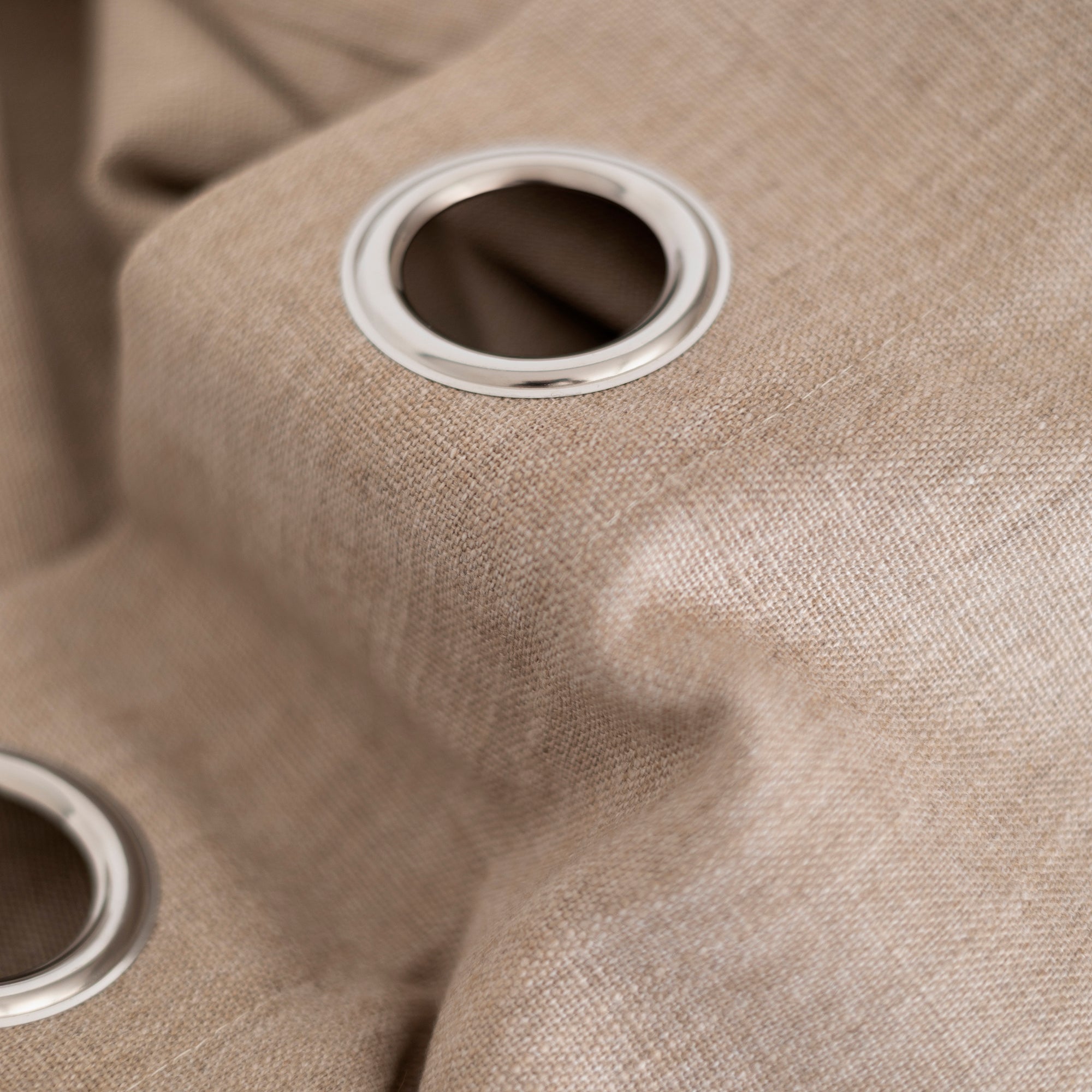

With eyelets
Slide the pole through the eyelets and it is hung. No rings, no hooks. A clean, even drape.
Includes iron-on hemming tape
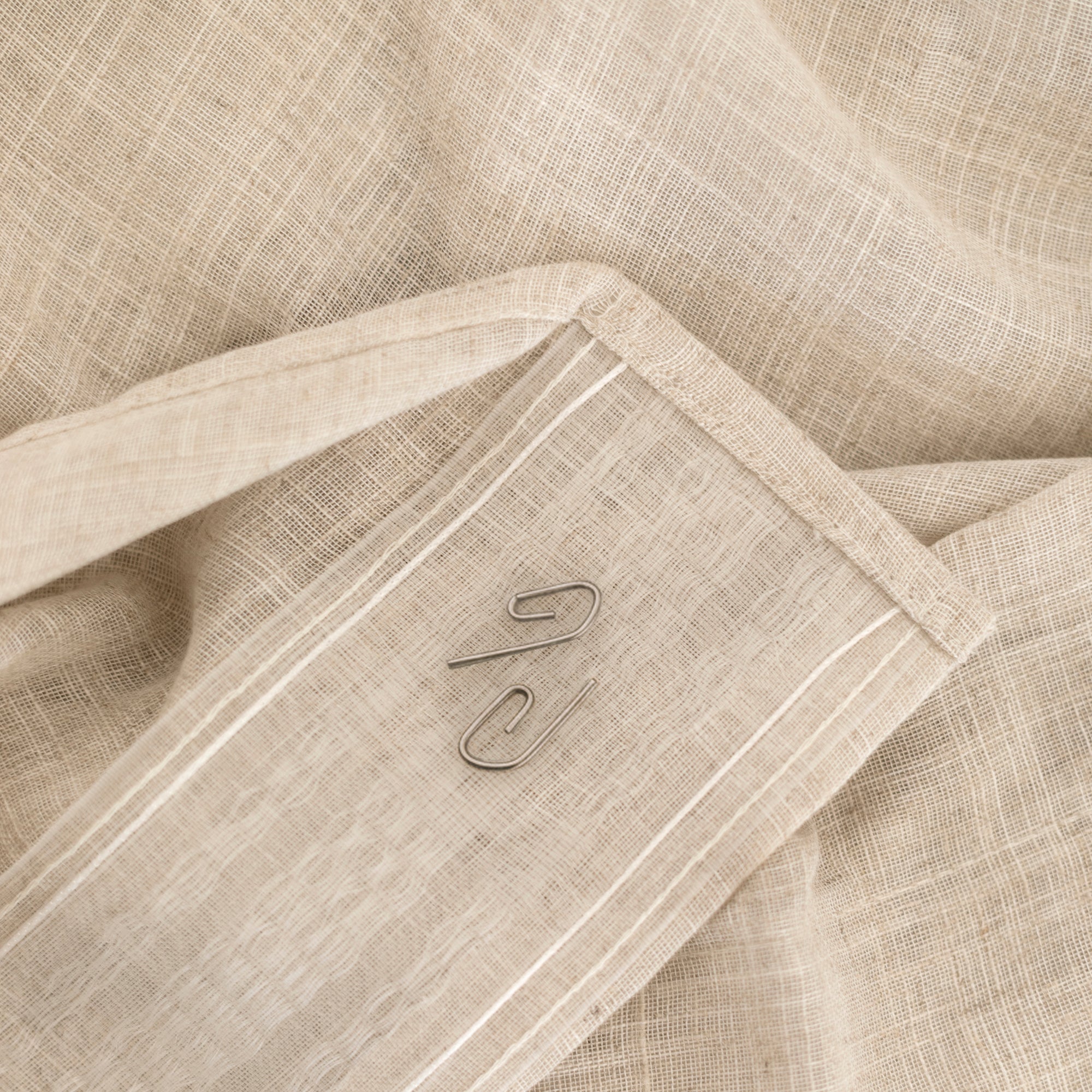

With gathering tape
With hooks for a track or straight onto a pole. You choose the finish, from a decorative gather to a smooth drape.
Includes iron-on hemming tape
Three opacities: how much light you want to let in
Opacity is what changes a room most, and it is where people most often get it wrong when buying curtains. It is not about choosing the densest: it is about knowing what you want to do with the light you already have.
Low opacity: sheer curtains
This is what other shops list as sheer, translucent or semi-transparent curtains. Ideal for bringing light and lightness to any space. Its low opacity gently filters daylight, creating a relaxed, calm atmosphere. It suits rooms that are already bright and that you do not want to darken, and works best when the curtain is there for its drape and colour rather than to cover.
Medium opacity: the balance
It strikes a balance between light and privacy. It lets light through but blocks the view from the street, so it is the middle option and the most versatile: it works in a living room facing the pavement, a ground-floor dining room or any window where you want to keep the light without feeling exposed.
High opacity: the most light-reducing
The densest of the three. It greatly reduces the light coming in and gives the most privacy. Because the fabric is thicker it also helps a little with the room temperature, although it is not a thermal curtain with an insulating lining. Many people search for this as a “blackout curtain”, and it is worth being clear: it darkens a lot, but it is not a blackout that leaves the room pitch dark. If you need total darkness, this is not it.
None of the three is a blackout curtain. And another important point: opacity does not depend on colour. A light print can be medium opacity and a dark plain can be low opacity. Each product shows its level on its page.
| Low opacity | Medium opacity | High opacity | |
|---|---|---|---|
| Also called | Sheer, voile | Semi-opaque | Light-reducing |
| Light coming in | Plenty, filtered | Moderate | Little |
| Privacy by day | Low | Good | High |
| Leaves the room dark | No | No | No, darkens a lot |
| Feel | Light and bright | Balanced | Cosy |
| Where it works | Bright rooms, voiles | Living room, dining room | Bedroom |
None of the three is blackout.
Fabrics: each model has its own
We do not work with a single composition. Each curtain has the fabric that suits what it does: some are designed to filter light and others to give body and drape, and the fabric changes with that job. The exact composition and washing instructions are on each product page, and it is worth checking them before deciding.
Our linen curtains are a 70/30 blend
Our linen curtains are 70% viscose and 30% linen, and it is a decision about quality, not price. The linen brings the irregular texture you see against the light and that lived-in feel; the viscose brings what pure linen lacks, which is drape and stability.
A fabric with body and plenty of drape
The weight is what you notice when you hang it: it falls straight and the folds hold themselves from top to bottom. It is the fabric to choose when you want the curtain to have presence and volume. For the opposite, a fabric that moves with the air and lets light through, what you want is a voile: they are two different things and each does its own job well.
No creases, thanks to the viscose
The blend is the key: pure linen creases, and in a curtain that means living with marks that never go away. The viscose prevents exactly that: it keeps the surface smooth and the drape clean in everyday use, without giving up the linen texture. You do not have to iron it every time you take it down.
Voile: the low-opacity curtain
Voile, sheer curtain and semi-transparent curtain are three names for the same thing, and in our catalogue it is listed as low opacity: the light fabric that filters light without blocking it and stays up all day. It can be used on its own or combined with a denser curtain on the same window, the voile by day and the other closed at night.
See all voiles, with the full guide to what they do with light and how to combine them.
Curtains by colour
A curtain is the largest textile surface in the room, so its colour sets the temperature of the whole space. The two neutrals do opposite things: white reflects the light and leaves it as it is, so it brightens and opens up; beige softens it as it passes through and adds warmth, which works especially well in rooms with little light or with wood.
Plain curtains and printed curtains
With the heading and opacity decided, what remains is what you see. And here there are two paths, which are not interchangeable: a plain curtain accompanies and a printed one leads.
Plain curtains
One colour in tone, no pattern. It is the option for a room that already has plenty going on — a patterned sofa, pictures, a patterned rug — because it lets everything else breathe. It is also the one that best stands the test of time: a plain never goes out of fashion and does not force you to change anything else when you refresh the cushions.
Printed curtains
Our own designs, developed in our studio and digitally printed: florals, stripes, leaves and geometrics. A print at the window becomes the starting point for decorating the whole room. It is the choice for plain rooms that need character, and for anyone who prefers the colour to be at the window rather than in the furniture.
Bedroom curtains
In the bedroom the curtain has a more specific job than decorating: it is what separates the room from the street lamp and the summer sunrise. Here high opacity is the right choice, with the usual warning: it darkens a lot, but it is not blackout.
Voile by day, curtain by night
The combination that works best in a bedroom that is also used during the day: a low-opacity voile that stays up and a high-opacity curtain that you close at bedtime. With multi-purpose tape and a double track, both fit on the same window.
How to work out how many curtains you need
Measure the width of the pole or track, not the window, and multiply by two. That is the width of fabric you need for the curtain to have folds instead of hanging tight. Each curtain is one panel, so a window with two panels means two units, and a wide balcony door usually needs four.
For the drop, measure from where the pole will go down to the floor and subtract one centimetre. If there is fabric left over, the hem is trimmed and fixed with the iron-on tape included. What you cannot do is lengthen a curtain, so measure before you order.

How to hang a curtain, step by step
It works for both headings. The difference is in step two: eyelets go straight onto the pole, multi-purpose tape takes hooks, a pole or a track.
01
Decide where the pole goes
Two measurements. Height: the closer to the ceiling, the taller the room looks. Width: let it extend about 15 cm beyond each side of the window, so that the open curtain sits outside the frame and does not cover the glass.
02
Hang the curtain
With eyelets, slide the pole through the metal rings and you are done. With multi-purpose tape, fit the hooks into the tape and hang them on the track, or slide the pole through the tape itself.
03
Mark the hem with the curtain hanging
Let it fall, mark where it touches the floor and take it down. It is more reliable than measuring the wall, because the fabric has already settled under its own weight.
04
Adjust the hem with the iron
Fold at the mark, place the iron-on tape that comes included and iron. It stays in place, with no sewing and no visible seam.
Dare to let the curtain pool
The rule says the hem should just brush the floor. The exception interior designers use says otherwise: leave 20 or 30 cm extra and let the fabric gather on the floor. It is called puddling and it is what gives a room that lived-in feel rather than a just-handed-over flat. It works especially well in living rooms and bedrooms with high ceilings, and with fabrics that drape well.
Two honest warnings: the part that pools picks up dust and needs shaking more often, and it is not a good idea on a window you walk past every day or in homes with pets or small children. If the curtain is opened and closed daily, better one centimetre off the floor.
Design notes
From our creative studio in Cocentaina, Alicante
Designing against the lightA curtain is the only textile in the home that is seen against the light. The rest of home textiles receive light from the front, but a curtain has it behind, passing through it, and that completely changes how a colour behaves and how a print reads.
The team tests every design hanging up with the window behind it, not on the table: how the colour opens up when light passes through it, which part of the pattern disappears in the folds and how everything changes between morning and dusk. A print that works flat can fall apart at a window, and vice versa.

Aitana · Happyfriday Design Team
Creative studio · Cocentaina, Spain
 Made in Spain
Every print starts life in our studio in Cocentaina (Alicante) and is printed and made up in workshops in Spain. Digital printing works like a large-format printer: it applies the ink directly onto the fabric. That is why it allows prints with many colours, gradients and fine detail. All our textiles are certified OEKO-TEX® STANDARD 100 Class I: AITEX, an independent laboratory, tests them for substances harmful to health.
Own design
Made in Spain
Digital printing
OEKO-TEX® Class I
How to wash and care for curtains
Each fabric has its instructions on the label and it is worth checking them before the first wash, because not all curtains can go in the washing machine. What they all have in common is below.
Check the label before washing
Some fabrics go in the washing machine and others need dry cleaning. Each product page shows the right care, and it is the first thing to check.
Protect the heading
Metal eyelets can take washing, but they knock against the drum. If you can, fold the top inwards or put the curtain in a fabric bag. Take the hooks out of multi-purpose tape first.
Shake them now and then
A curtain gathers dust more than dirt. Shaking it or going over it with the soft brush of the vacuum cleaner stretches the time between washes quite a bit.
Frequently asked questions about curtains
Is the price for one curtain or a pair?
For one curtain. Each item is one panel, so to dress a window with two panels you need to order two units. For wide windows or balcony doors four is usual, two on each side.
What is the difference between eyelets and multi-purpose tape?
Eyelets are metal rings that the pole slides straight through: quick to hang, a clean and even drape, and a more contemporary style. Multi-purpose tape, also known as gathering tape, is a tape sewn along the top that lets you hang the curtain with hooks, on a pole or on a track, and choose the finish, from a decorative gather to a smoother, more relaxed drape. If you have a track, this is the heading you need: eyelet curtains need a pole to pass through the rings.
Which curtain should I put in the kitchen?
It depends on the kitchen. If it is open to the living room or has a large window, the curtain goes long and with the same heading and colour as the living room, so as not to split the space in two; medium opacity works best. If the window is small and above the worktop, it is best to adjust the hem so it does not reach the floor. Either way, check on the product page that the fabric is machine washable: in a kitchen, fabric picks up steam and grease and is washed more often.
Are they thermal or insulating curtains?
Not in the technical sense. A thermal curtain has an insulating lining or coating on the inside, and ours do not. What does happen is that a thick fabric hanging in front of the glass traps a little air and helps a bit with the temperature, like any heavy fabric. If you are looking for real insulation to cut your heating, you need a curtain with a thermal lining.
Are they blackout curtains? Do they leave the room dark?
Our densest level is high opacity, and it is what many people search for as a blackout curtain: it greatly reduces the light coming in and gives the most privacy. But it is not a blackout: it darkens without leaving the room completely dark. Some light also comes in at the sides and top, as with any curtain. If you need total darkness, it is worth knowing before you order.
What are the linen curtains like?
Our linen curtains are a blend of 70% viscose and 30% linen. The linen gives the texture you see against the light and the viscose gives the drape and prevents the heavy creasing of pure linen: a thick, heavy fabric that falls straight and holds its folds without ironing. The other models have other compositions, each shown on its product page.
Which opacity should I choose?
Low if you want light and lightness and do not mind being seen from outside. Medium if you want a balance between light and privacy, which is what most living rooms need. And high if you need the most privacy and much less light, as in a bedroom.
Are a voile and a sheer curtain the same thing?
In practice yes, and so is what we list here as low opacity. Voile is the traditional name for the light fabric that filters light without blocking it and stays up all day. You will find the full guide in the voiles collection.
Can the length be adjusted without sewing?
Yes, and everything you need is included. Each curtain comes with iron-on hemming tape: fold the hem wherever you want, place the tape inside the fold and iron. It stays in place, holds up to washing and no seam shows on the outside.
How much fabric do I need for it to have folds?
As a rule, twice the width of the pole or track. If the panels add up to exactly the width of the opening, the curtain hangs tight and flat; the extra fabric is what forms the folds.
How high should the pole go?
As close to the ceiling as the wall allows, not just above the window frame, and about 15 cm wider than the opening on each side. Hanging high makes the room look taller and stops the open curtain covering part of the glass.
Can they go in the washing machine?
It depends on the fabric. Some can be machine washed and others need dry cleaning, so it is worth checking the label and the product page before the first wash. With washable ones, hanging them back up while still damp saves you ironing.
Can I put two curtains on the same window?
Yes, and it is the combination that works best in a bedroom that is also used during the day: a low-opacity voile that stays up and a high-opacity curtain that you close at night. You need a double track or two poles, and multi-purpose tape is the heading to choose.
Are Happyfriday curtains made in Spain?
Yes. They are designed in our studio in Cocentaina (Alicante) and made up in workshops in Spain; the printed ones are also printed there. The prints are developed by our design team from the very first sketch.